

You've seen affirmations everywhere - on Instagram, in journals, on cards. But here's the question nobody answers honestly: Do they actually work, or are they just pretty words?
The answer, backed by neuroscience and over 17,700 research participants, is yes. With one important catch.
What Are Affirmations, Really?
Affirmations are intentional, present-tense statements designed to reinforce self-worth and emotional stability. Think of them as mental reps, the same way you'd train a muscle, you're training a thought pattern.
In psychological terms: affirmations help shift your nervous system from threat mode to grounded mode.
And your brain responds measurably when you do them consistently.
What Happens in Your Brain When You Affirm
This is where it gets fascinating.
Functional MRI (fMRI) studies show that self-affirmation activates brain regions responsible for:
- Self-related processing (how you see yourself)
- Reward and value systems (how motivated and hopeful you feel)
- Emotional regulation (how well you manage stress)
In other words, affirmations aren't just feel-good fluff. They light up the same reward circuitry as experiences you genuinely value.
Why Repetition Is the Whole Point: Neuroplasticity Explained
Here's the science term that changes everything: neuroplasticity - your brain's ability to reorganise and strengthen neural pathways through repeated use.
Every time you repeat a thought, you're reinforcing a neural groove. Affirmations work not because of what you say once, but because of what you keep returning to.
With consistent practice, research shows affirmations can:
- Weaken rigid, automatic negative self-talk
- Strengthen more compassionate, adaptive beliefs
- Build emotional flexibility and resilience over time
The Research Is Clear
Still sceptical? Here's what the data says:
- Even brief self-affirmation practices can reduce stress reactivity immediately in high-pressure situations
- Measurable improvements in self-perception and emotional wellbeing are typically seen after just 2-4 weeks of consistent practice
- A 2025 meta-analysis reviewing 67 studies and over 17,700 participants found that self-affirmation interventions produced meaningful, lasting improvements in self-perception and emotional wellbeing - with some benefits growing stronger over time
The takeaway: affirmations are a long-term practice, not a quick fix. And like any practice, the tool you use matters.
Why Physical Affirmation Cards Beat Scrolling Through Your Phone
Here's something the research supports: how you engage with affirmations affects how well they work.
Physical affirmation cards create something a screen can't replicate:
- Intentional pauses - a moment that's just yours, not competing with notifications
- Embodied engagement - holding something, reading slowly, sitting with it
- Anchored practice - attached to a real moment in your day, not a swipe
Studies on mindfulness and habit formation consistently show that tactile, offline rituals build stronger neural associations than passive digital consumption.
But Here's What Most Affirmation Cards Get Wrong
Most affirmation cards are written for a generic, Western audience, with language, imagery, and cultural context that simply doesn't reflect everyone's lived experience.
If an affirmation doesn't resonate with who you actually are, your culture, your language, your values, your faith, it won't land the same way in your brain. Research on psychological safety shows that feeling seen and reflected is foundational to emotional wellbeing.
That's the gap Tala Thrive was built to fill.
Introducing the Only Culturally Specific Affirmation Cards on the Market
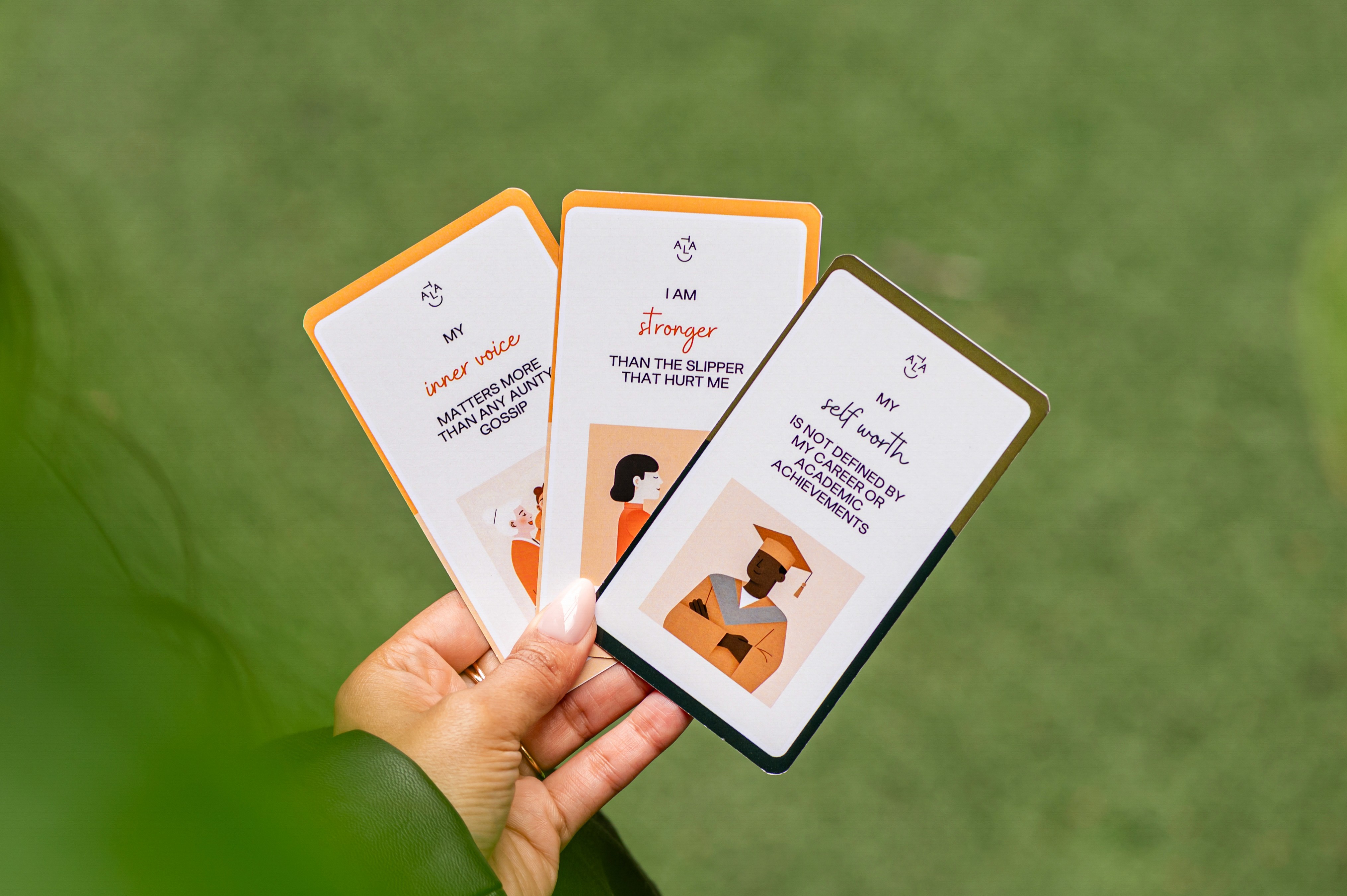
Tala Thrive affirmation cards are the only affirmation cards designed with cultural specificity at their core, created for communities whose mental health journeys are shaped by culture, language, faith, and identity.
These aren't generic statements with a new colour palette. They're words written for you, by people who personally understand your world.
When your affirmations actually reflect your lived experience:
- They activate deeper emotional resonance
- They're easier to internalise and believe
- They become a genuine anchor, not just a daily ritual you go through the motions of
Your Mental Health Deserves to See Itself Reflected
Supporting your mental wellbeing doesn't have to look one-dimensional. Some days you need the right words to return to. Other days, you need to speak with someone who truly gets it.
At Tala Thrive, we offer both.
Our culturally specific affirmation cards support emotional grounding through small, intentional daily moments. And our therapy and coaching services connect you with culturally competent therapists and coaches who understand your culture, language, and/or religion.
The only culturally specific affirmation cards on the market.
Book a Session with a Culturally Competent Therapist or Coach
Remember, we want you to thrive - mentally, physically, and emotionally - so you can start living the life you truly deserve.